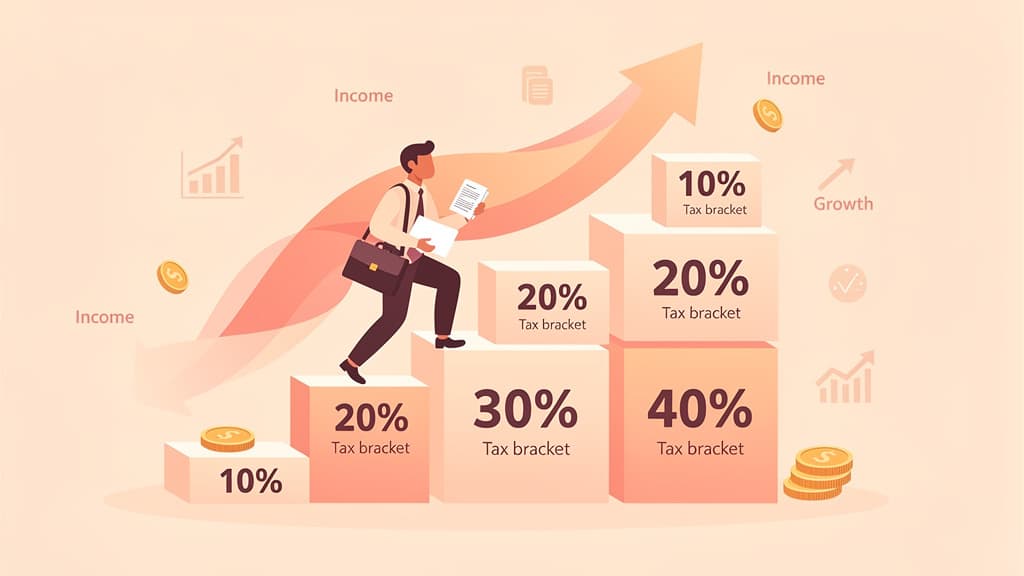
The IRS set the 2026 federal income tax brackets in Revenue Procedure 2025-32, published in October 2025: seven rates from 10% to 37%, with a single filer paying 10% on taxable income up to $12,400 and reaching the top 37% rate above $640,600. Revenue Procedure 2025-32 also sets the 2026 capital gains brackets, a separate schedule where long-term gains are taxed at 0%, 15%, or 20%. Because the brackets are marginal, only the income inside each range is taxed at that range's rate, so your effective rate is always lower than your bracket.
Key takeaways:
- Revenue Procedure 2025-32 sets seven 2026 ordinary income rates: 10%, 12%, 22%, 24%, 32%, 35%, 37%
- 2026 standard deduction: $16,100 single, $32,200 married filing jointly, $24,150 head of household
- 2026 long-term capital gains brackets (single): 0% up to $49,450, 15% to $545,500, 20% above
- Marginal is not effective: a single filer with $85,000 of taxable income is "in the 22% bracket" but pays an effective rate of 15.8%
- Self-employment tax (15.3%) is calculated separately and applies on top of the income tax brackets
| Tax Rate | Taxable Income Range |
|---|
| 10% | $0 – $12,400 |
| 12% | $12,401 – $50,400 |
| 22% | $50,401 – $105,700 |
| 24% | $105,701 – $201,775 |
| 32% | $201,776 – $256,225 |
| 35% | $256,226 – $640,600 |
| 37% | $640,601+ |
Standard deduction (single): $16,100, subtracted from gross income before the brackets apply.
Legal basis: IRC §1 (tax rates), IRS Revenue Procedure 2025-32 (2026 inflation adjustments), One Big Beautiful Bill Act (OBBBA) permanent individual rate structure.

Think of your income as water filling a series of buckets. Each bucket represents a bracket. The first bucket (10%) fills up first. Only after it overflows does income pour into the next bucket (12%), and so on.
Example: single filer with $85,000 taxable income
| Bracket | Income taxed in bracket | Tax |
|---|
| 10% on $0 – $12,400 | $12,400 | $1,240 |
| 12% on $12,401 – $50,400 | $38,000 | $4,560 |
| 22% on $50,401 – $85,000 | $34,600 | $7,612 |
| Total | $85,000 | $13,412 |
Marginal rate: 22% (the bracket on your last dollar)
Effective rate: $13,412 ÷ $85,000 = 15.8%
Your effective rate is 15.8%, not 22%. That gap between marginal and effective rate exists for every taxpayer in every bracket.
When someone says "I'm in the 24% bracket," it does not mean they pay 24% on everything. A single filer who just crossed into the 24% bracket at $105,701 pays an effective rate of about 17%. The 24% rate only applies to the dollars above $105,700.
The practical takeaway: Never turn down income to stay in a lower bracket. You will always keep more than you pay in taxes on additional income.
| Rate | Taxable Income | Tax on Bracket |
|---|
| 10% | $0 – $12,400 | Up to $1,240 |
| 12% | $12,401 – $50,400 | Up to $4,560 |
| 22% | $50,401 – $105,700 | Up to $12,166 |
| 24% | $105,701 – $201,775 | Up to $23,058 |
| 32% | $201,776 – $256,225 | Up to $17,424 |
| 35% | $256,226 – $640,600 | Up to $134,531 |
| 37% | $640,601+ | No limit |
Standard deduction: $16,100
| Rate | Taxable Income | Tax on Bracket |
|---|
| 10% | $0 – $24,800 | Up to $2,480 |
| 12% | $24,801 – $100,800 | Up to $9,120 |
| 22% | $100,801 – $211,400 | Up to $24,332 |
| 24% | $211,401 – $403,550 | Up to $46,116 |
| 32% | $403,551 – $512,450 | Up to $34,848 |
| 35% | $512,451 – $768,700 | Up to $89,688 |
| 37% | $768,701+ | No limit |
Standard deduction: $32,200
| Rate | Taxable Income |
|---|
| 10% | $0 – $12,400 |
| 12% | $12,401 – $50,400 |
| 22% | $50,401 – $105,700 |
| 24% | $105,701 – $201,775 |
| 32% | $201,776 – $256,225 |
| 35% | $256,226 – $384,350 |
| 37% | $384,351+ |
Standard deduction: $16,100
Note: MFS thresholds are generally half the MFJ amounts, except for the 35% and 37% brackets, where MFS hits the 37% rate at $384,351, far below the MFJ threshold of $768,701.
| Rate | Taxable Income |
|---|
| 10% | $0 – $17,700 |
| 12% | $17,701 – $67,450 |
| 22% | $67,451 – $105,700 |
| 24% | $105,701 – $201,775 |
| 32% | $201,776 – $256,200 |
| 35% | $256,201 – $640,600 |
| 37% | $640,601+ |
Standard deduction: $24,150
Who qualifies as HOH? Unmarried taxpayers who pay more than half the cost of maintaining a home for a qualifying dependent. HOH brackets are wider than single filer brackets, resulting in lower taxes at the same income level.
Your marginal rate is the tax rate applied to your last dollar of income. It tells you how much additional income will be taxed, which is useful for quick decisions about whether to take on more work or make deductible purchases.
Example: A single filer with $120,000 in taxable income is in the 24% marginal bracket. If they earn another $1,000, that extra income is taxed at 24%, costing $240 in additional tax.
Your effective rate is your total federal income tax divided by your total taxable income. It gives the real picture of your overall tax burden.
Detailed calculation: single filer, $120,000 taxable income
| Bracket | Tax |
|---|
| 10% on first $12,400 | $1,240 |
| 12% on $12,401 – $50,400 | $4,560 |
| 22% on $50,401 – $105,700 | $12,166 |
| 24% on $105,701 – $120,000 | $3,432 |
| Total tax | $21,398 |
Effective rate: $21,398 ÷ $120,000 = 17.8%
The marginal rate is 24%, but the effective rate is 17.8%. Every taxpayer's effective rate is lower than their marginal rate.
Use our Effective Tax Rate Calculator to see your actual rate, or try our Income Tax Calculator for a full breakdown.
If you are self-employed, your income goes through multiple tax layers. Understanding the order matters for planning.
Start with gross business revenue minus business deductions on Schedule C. The result is your net profit.
Gross revenue $130,000 − business deductions $25,000 = net profit $105,000 (Schedule C).
Self-employment tax is calculated independently from your income tax brackets. It applies to 92.35% of your net profit at a flat 15.3% rate.
$105,000 × 92.35% = $96,968, and $96,968 × 15.3% = $14,836 of SE tax.
This SE tax is not affected by your bracket. It is a flat rate. The only way to reduce it is to reduce your net self-employment earnings. See our Self-Employment Tax Guide.
You deduct half of your SE tax ($7,418) from your gross income on Schedule 1. This reduces your AGI.
Your AGI is further reduced by the standard deduction and, for most self-employed filers, the 20% Qualified Business Income (QBI) deduction.
| Line | Amount |
|---|
| Net profit (Schedule C) | $105,000 |
| Less half of SE tax | -$7,418 |
| Adjusted gross income | $97,582 |
| Less standard deduction | -$16,100 |
| Less QBI deduction (20%) | -$21,000 |
| Taxable income | $60,482 |
10% × $12,400 = $1,240, plus 12% × $38,000 = $4,560, plus 22% × $10,082 = $2,218. Total income tax: $8,018.
| Component | Amount |
|---|
| Self-employment tax | $14,836 |
| Federal income tax | $8,018 |
| Total | $22,854 |
Effective total rate: $22,854 ÷ $105,000 = 21.8%
Notice that the SE tax ($14,836) is nearly double the income tax ($8,018). For many self-employed individuals earning under $100K, self-employment tax is actually the larger component.
Use our Self-Employment Tax Calculator to model your specific numbers.
The Qualified Business Income (QBI) deduction under IRC §199A allows most self-employed individuals and pass-through business owners to deduct 20% of their qualified business income. This deduction was made permanent by the One Big Beautiful Bill Act in July 2025.
The QBI deduction reduces your taxable income, which means less of your income is exposed to higher brackets.
Single filer with $100,000 net profit:
| Line | Without QBI | With QBI |
|---|
| AGI after half-SE-tax deduction | $92,922 | $92,922 |
| Less standard deduction | -$16,100 | -$16,100 |
| Less QBI (20% of $100,000) | $0 | -$20,000 |
| Taxable income | $76,822 | $56,822 |
| Top bracket | 22% | 22% (but less income in it) |
The QBI deduction pulls $20,000 out of the 22% bracket, saving $4,400 in income tax.
Important: The QBI deduction reduces income tax only. It has no effect on self-employment tax. The examples here use the simplified 20%-of-net-profit figure; on the actual return, Form 8995 reduces QBI by the deductible half of SE tax before applying the 20%, so the final number lands slightly lower.
For a deeper look, read our QBI Deduction Guide.
Long-term capital gains (assets held more than one year) are taxed at preferential rates, separate from the ordinary income brackets above. Revenue Procedure 2025-32 sets the 2026 capital gains brackets alongside the ordinary brackets.
| Rate | Single | Married Filing Jointly | Head of Household |
|---|
| 0% | Up to $49,450 | Up to $98,900 | Up to $66,200 |
| 15% | $49,451 – $545,500 | $98,901 – $613,700 | $66,201 – $579,600 |
| 20% | Over $545,500 | Over $613,700 | Over $579,600 |
For married filing separately, the 0% bracket ends at $49,450 and the 15% bracket at $306,850.
These thresholds are based on your total taxable income (ordinary income plus capital gains combined).
Example: A single filer with $40,000 in W-2 income and $15,000 in long-term capital gains has total taxable income of $55,000. Their W-2 income is taxed at ordinary rates. The capital gains portion: the first $9,450 ($49,450 - $40,000) is taxed at 0%, and the remaining $5,550 at 15%.
Short-term gains (assets held one year or less) get no preferential rate; they are taxed in the ordinary brackets in this guide. For holding-period rules, netting, and strategies, see our Short-Term vs Long-Term Capital Gains Guide.
High-income taxpayers may also owe the 3.8% Net Investment Income Tax on capital gains and other investment income when modified AGI exceeds $200,000 (single) or $250,000 (MFJ). These thresholds are not indexed for inflation.
The AMT is a parallel tax system designed to ensure high-income taxpayers pay a minimum level of tax, even with significant deductions.
| Single / HOH | Married Filing Jointly |
|---|
| Exemption amount | $90,100 | $140,200 |
| Phase-out begins | $500,000 | $1,000,000 |
| AMT rates | 26% / 28% | 26% / 28% |
Who should worry about AMT? Taxpayers with large state and local tax deductions (SALT), significant capital gains, or exercised incentive stock options. Most W-2 employees and self-employed individuals under $200K in income are not affected.
The SALT deduction cap ($40,400 for 2026; the OBBBA raised the cap from $10,000 to $40,000 in 2025, with 1% annual increases through 2029) still reduces AMT exposure compared with the pre-2018 unlimited SALT deduction, which was one of the primary AMT triggers.
The 2026 brackets reflect approximately 2.7% inflation adjustments from 2025 levels.
| Rate | 2025 Threshold | 2026 Threshold | Change |
|---|
| 10% | $0 – $11,925 | $0 – $12,400 | +$475 |
| 12% | $11,926 – $48,475 | $12,401 – $50,400 | +$1,925 |
| 22% | $48,476 – $103,350 | $50,401 – $105,700 | +$2,350 |
| 24% | $103,351 – $197,300 | $105,701 – $201,775 | +$4,475 |
| 32% | $197,301 – $250,525 | $201,776 – $256,225 | +$5,700 |
| 35% | $250,526 – $626,350 | $256,226 – $640,600 | +$14,250 |
| 37% | $626,351+ | $640,601+ | +$14,250 |
| Filing Status | 2025 | 2026 | Change |
|---|
| Single | $15,750 | $16,100 | +$350 |
| MFJ | $31,500 | $32,200 | +$700 |
| HOH | $23,625 | $24,150 | +$525 |
The OBBBA permanently locked in the seven-bracket rate structure from the Tax Cuts and Jobs Act, which was set to expire after 2025. Without OBBBA, rates would have reverted to the pre-2018 structure with rates as high as 39.6%.
Problem: A freelancer earning $100,000 believes their entire income is taxed at 22% because they are "in the 22% bracket."
Impact: Overestimating tax liability by thousands of dollars. The actual effective rate on $100,000 of taxable income (single filer) is about 16.7%, not 22%.
Solution: Remember that brackets are marginal. Only income within each range is taxed at that bracket's rate. Use our Tax Bracket Calculator to see the breakdown.
Problem: A W-2 employee earning $65,000 salary looks at the bracket table and assumes they are in the 22% bracket.
Impact: After subtracting the $16,100 standard deduction, their taxable income is $48,900, putting them barely into the 12% bracket, not the 22% bracket.
Solution: Always subtract the standard deduction (or itemized deductions) from gross income before looking at brackets.
Problem: A freelancer calculates only their income tax and budgets accordingly, then gets hit with an additional 15.3% SE tax they did not plan for.
Impact: At $80,000 net profit, SE tax alone is approximately $11,304. Combined with roughly $4,800 of income tax (after the standard deduction and QBI deduction), the total federal bill lands near $16,000, about 20% of net profit, and most of it is SE tax the freelancer never budgeted for.
Solution: Self-employed individuals need to add SE tax on top of income tax. Budget 25-30% of net profit for total federal taxes. See our Self-Employment Tax Guide.
Problem: An unmarried parent files as Single instead of Head of Household, missing wider brackets and a larger standard deduction.
Impact: On $80,000 of gross income, filing as HOH instead of Single saves roughly $2,400 in federal income tax due to the larger standard deduction ($24,150 vs. $16,100) and wider bracket ranges.
Solution: If you are unmarried, paid more than half the cost of keeping up a home, and have a qualifying dependent, you likely qualify for HOH filing status.
Problem: A self-employed individual calculates their brackets based on AGI minus the standard deduction, forgetting the 20% QBI deduction that further reduces taxable income.
Impact: Missing a deduction worth 20% of qualified business income. On $100,000 of QBI, that is $20,000 less in taxable income, saving $4,400+ in the 22% bracket.
Solution: If you are self-employed or own a pass-through entity, apply the QBI deduction after the standard deduction and before determining your bracket. Read our QBI Deduction Guide.
Brackets only tell you the rate on your next dollar. What you actually owe depends on Schedule C deductions, the QBI deduction, and self-employment tax stacked together. Jupid is an AI accountant that connects to your bank, categorizes business transactions with 95.9% accuracy, and keeps a running estimate of your taxable income, so you can see which bracket you are actually in before year-end instead of discovering it in April. Ask "what's my effective rate right now?" in WhatsApp or iMessage and get an answer based on your real numbers, not a guess. Try Jupid
- IRC §1 — Tax imposed (rate tables for each filing status)
- IRC §63 — Taxable income defined (standard deduction)
- IRC §199A — Qualified Business Income deduction (20%)
- IRC §1401 — Self-employment tax rates
- IRC §55-59 — Alternative Minimum Tax
- One Big Beautiful Bill Act (OBBBA) — Made individual tax rates permanent and raised the SALT cap
| Item | 2026 Amount |
|---|
| Standard deduction (single) | $16,100 |
| Standard deduction (MFJ) | $32,200 |
| Standard deduction (HOH) | $24,150 |
| Top marginal rate | 37% (over $640,601 single) |
| QBI deduction | 20% of qualified business income |
| SE tax rate | 15.3% on 92.35% of net earnings |
| Social Security wage base | $184,500 |
| SALT deduction cap | $40,400 |
| AMT exemption (single) | $90,100 |
| LTCG 0% threshold (single) | $49,450 |
| NIIT threshold (single) | $200,000 |
The 2026 tax bracket system is progressive, designed so that higher rates only apply to income above each threshold. Your effective rate is always lower than your marginal rate.
Three things to remember:
- Brackets are marginal, not total — Moving into a higher bracket does not retroactively raise the tax on income in lower brackets. Additional income is always worth earning.
- Deductions shift your bracket exposure — The standard deduction, QBI deduction, and business expenses all reduce your taxable income before brackets apply. Every dollar of deduction can save you your marginal rate.
- Self-employment tax is separate — If you are self-employed, the 15.3% SE tax applies on top of income tax brackets. Plan for both when estimating your total liability.
Understanding how brackets work is the foundation of tax planning. Everything else, from timing income to maximizing deductions to choosing a business structure, builds on knowing your marginal rate and how to reduce your effective rate.
Disclaimer
This article provides general information about federal income tax brackets and should not be considered tax advice. Tax rates, brackets, deductions, and thresholds are subject to annual inflation adjustments and legislative changes. Your actual tax liability depends on your specific income, deductions, credits, and filing status. For advice tailored to your situation, consult with a qualified tax professional.
Last Updated: July 7, 2026