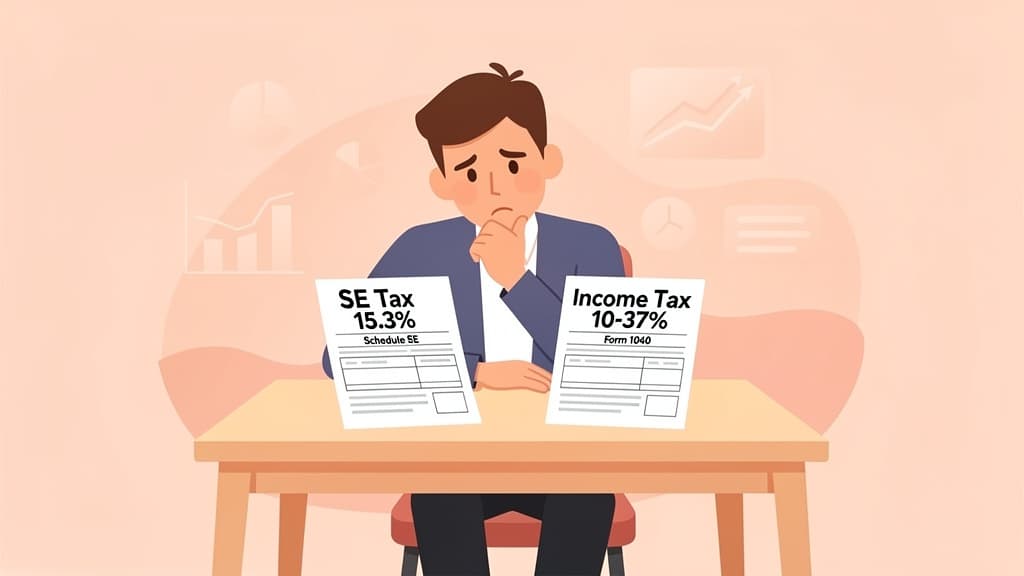
Self-employment tax and income tax are two separate federal bills, and self-employed people owe both on the same profit. Self-employment (SE) tax is a flat 15.3% (12.4% Social Security plus 2.9% Medicare) charged on 92.35% of your net profit, with no standard deduction to shrink it. Income tax is the progressive 10%-37% system you already know, charged on taxable income after deductions. On $100,000 of net profit, a single filer owes roughly $14,130 in SE tax and about $8,500 in income tax: about $22,700 combined, an effective rate near 22.7%.
Key takeaways:
- SE tax is 15.3% (12.4% Social Security + 2.9% Medicare) on 92.35% of net profit. The Social Security portion stops at the $184,500 wage base for 2026.
- Income tax runs the 10%-37% brackets on taxable income after deductions. SE tax uses one flat rate and gets no standard deduction.
- You pay both on the same profit. For freelancers earning $40,000-$100,000, SE tax is usually the larger of the two bills.
- You deduct half of your SE tax (IRC §164(f)) against income tax, and most freelancers also take the 20% QBI deduction (§199A, made permanent by OBBBA).
- SE tax starts at $400 of net self-employment earnings and is paid alongside income tax through quarterly estimates on Form 1040-ES.
| Feature | Self-Employment Tax | Federal Income Tax |
|---|
| Rate | 15.3% flat (12.4% SS + 2.9% Medicare) | 10%-37% progressive brackets |
| Calculated on | 92.35% of net profit | Taxable income (after deductions) |
| Reported on | Schedule SE | Form 1040 |
| Standard deduction applies? | No | Yes ($16,100 single / $32,200 MFJ) |
| Income cap | SS portion stops at $184,500 | No cap; applies to all taxable income |
| Who pays | Self-employed individuals only | Everyone with income |
| Equivalent for W-2 workers | FICA (split 50/50 with employer) | Same income tax brackets |
2026 quick math for $100,000 net profit (single filer):
| Tax | Calculation | Amount |
|---|
| SE Tax | $100,000 × 92.35% × 15.3% | $14,130 |
| Half SE Tax Deduction | $14,130 ÷ 2 | −$7,065 |
| AGI | $100,000 − $7,065 | $92,935 |
| Standard Deduction | $16,100 | −$16,100 |
| QBI Deduction (20%) | $76,835 × 20% | −$15,367 |
| Taxable Income | $92,935 − $16,100 − $15,367 | $61,468 |
| Federal Income Tax | Brackets applied | ~$8,527 |
| Total Federal Tax | SE Tax + Income Tax | ~$22,657 |
| Effective Rate | $22,657 ÷ $100,000 | ~22.7% |
Legal basis: IRC §1401 (SE tax rates), IRC §1 (income tax rates), IRC §164(f) (deduction for half of SE tax), IRC §199A (QBI deduction).

Save this cheat sheet — both taxes, the 2026 numbers, and the quick math in one image.
Self-employment (SE) tax is your contribution to Social Security and Medicare. Every working person pays into these programs. The difference is how the payment works.
W-2 employees: your employer pays 7.65% (6.2% Social Security + 1.45% Medicare) and you pay 7.65%. The employer's share is invisible to you. It does not appear on your W-2 or paycheck.
Self-employed individuals: you pay both sides, the full 15.3%. There is no employer to split the cost, so Schedule SE calculates the entire amount. For a line-by-line walkthrough of that form, see the Schedule SE instructions guide.
Social Security (12.4%): applies to the first $184,500 of net self-employment earnings for 2026. This funds your retirement, disability, and survivor benefits. Once your earnings pass $184,500, the Social Security portion stops.
Medicare (2.9%): applies to all net self-employment earnings with no cap. Every dollar of profit is subject to the 2.9% Medicare tax.
Additional Medicare Tax (0.9%): applies to self-employment earnings above $200,000 (single) or $250,000 (married filing jointly). This brings the total Medicare rate to 3.8% on high earnings.
SE tax is calculated on 92.35% of your net self-employment income, not the full amount. This adjustment exists because W-2 employees do not pay income tax on the employer's share of FICA. The 92.35% multiplier gives self-employed individuals equivalent treatment.
Step by step on $80,000 net profit: multiply $80,000 by 92.35% to get $73,880. Social Security tax at 12.4% is $9,161. Medicare tax at 2.9% is $2,143. Total SE tax is $11,304.
The SE tax floor: you owe SE tax once net self-employment earnings reach $400 or more. Below that threshold, no SE tax is due.
Legal citation: IRC §1401(a) sets the Social Security rate, §1401(b) sets the Medicare rate, and §1402(a)(12) establishes the 92.35% multiplier. For a full deep dive on calculating SE tax alone, see the self-employment tax guide.
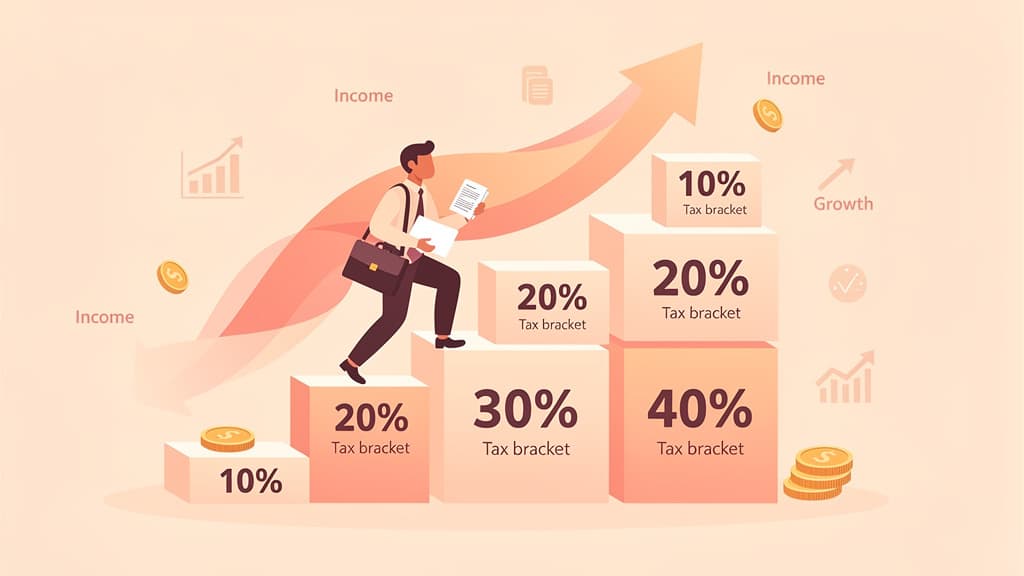
Federal income tax is the tax most people know. It applies to your taxable income (gross income minus deductions) using a progressive bracket system, where higher portions of income are taxed at higher rates.
| Taxable Income | Rate | Tax on Bracket |
|---|
| $0 – $12,400 | 10% | $1,240 |
| $12,401 – $50,400 | 12% | $4,560 |
| $50,401 – $105,700 | 22% | $12,166 |
| $105,701 – $201,775 | 24% | $23,058 |
| $201,776 – $256,225 | 32% | $17,424 |
| $256,226 – $640,600 | 35% | $134,531 |
| Over $640,600 | 37% | No limit |
How progressive brackets work: only the income within each bracket is taxed at that bracket's rate. On $60,000 of taxable income, the first $12,400 is taxed at 10% ($1,240), the next $38,000 at 12% ($4,560), and the last $9,600 at 22% ($2,112). Total income tax is $7,912, an effective rate of 13.2%.
Your marginal rate is 22%, but your effective rate is only 13.2% because most of your income was taxed at lower rates. Run your own numbers with the income tax calculator, and compare the two rates with the effective tax rate calculator.
Unlike SE tax, income tax benefits from deductions that reduce your taxable income before the rates apply:
Standard Deduction (2026):
- Single: $16,100
- Married filing jointly: $32,200
- Head of household: $24,150
Deduction for Half of SE Tax: you deduct 50% of your self-employment tax from gross income. This is an above-the-line deduction, so you get it whether you itemize or take the standard deduction.
Qualified Business Income (QBI) Deduction: the OBBBA made this permanent. Self-employed individuals can deduct 20% of their qualified business income, subject to income limits for certain service businesses.
Business Expenses (Schedule C): everything you deduct on Schedule C (home office, mileage at 72.5 cents per mile in 2026, supplies, software, insurance) reduces both your income tax and SE tax, because it lowers net profit.
The single biggest reason freelancers face higher total tax bills is the employer share of FICA. Here is a direct comparison for someone earning $80,000:
W-2 Employee ($80,000 salary):
| Tax | Calculation | Amount |
|---|
| Employee FICA | $80,000 × 7.65% | $6,120 |
| Federal income tax | After standard deduction | ~$7,912 |
| Total employee pays | | ~$14,032 |
| Employer FICA (hidden) | $80,000 × 7.65% | $6,120 |
| Total cost (both sides) | | ~$20,152 |
Self-Employed ($80,000 net profit):
| Tax | Calculation | Amount |
|---|
| SE tax (full 15.3%) | $80,000 × 92.35% × 15.3% | $11,304 |
| Half SE tax deduction | | −$5,652 |
| Federal income tax | After standard deduction + half SE + QBI | ~$6,228 |
| Total self-employed pays | | ~$17,532 |
The self-employed person pays about $3,500 more out of pocket. But the total economic cost, including the employer's hidden share for the W-2 worker, is actually similar. The difference is visibility: the employee never sees the employer's $6,120 contribution, while the freelancer writes one big check.
The other factor: the standard deduction and QBI deduction do not reduce SE tax. They only reduce income tax.
This means SE tax hits your full net profit (× 92.35%), regardless of filing status, standard deduction, or other tax adjustments. For many freelancers earning $40,000-$100,000, SE tax is actually the larger of the two bills.
Example at $60,000 net profit (single):
| Tax | Amount | % of Net Profit |
|---|
| SE Tax | $8,478 | 14.1% |
| Federal Income Tax | ~$3,771 | 6.3% |
| Total | ~$12,249 | 20.4% |
SE tax is more than double the income tax at this income level.
IRC §164(f) lets you deduct 50% of your self-employment tax when calculating adjusted gross income (AGI). This is one of the most important and most overlooked benefits for self-employed individuals.
Why it exists: W-2 employees do not pay income tax on their employer's share of FICA. The half-SE-tax deduction simulates this for self-employed individuals by letting you deduct the "employer-equivalent" portion.
How it flows through your return (starting from $90,000 net profit on Schedule C):
| Line | Amount |
|---|
| Net profit (Schedule C) | $90,000 |
| SE tax (Schedule SE) | $12,716 |
| Half of SE tax (to Schedule 1, line 15) | −$6,358 |
| Adjusted Gross Income | $83,642 |
| Standard deduction | −$16,100 |
| QBI deduction (20% of $67,542) | −$13,508 |
| Taxable income | $54,034 |
Critical detail: this deduction reduces your income tax, but it does NOT reduce your SE tax. The SE tax is calculated first, and then half of it becomes a deduction for income tax purposes.
The half-SE-tax deduction creates a cascading benefit:
- It lowers your AGI.
- Lower AGI means lower taxable income.
- Lower taxable income means lower income tax.
- Lower AGI may also qualify you for other tax benefits that phase out at higher income levels.
For every $10,000 in SE tax, you save roughly $1,100 to $1,700 in income tax (depending on your marginal bracket) through this deduction.
| Item | Amount |
|---|
| Net profit | $30,000 |
| SE tax ($30,000 × 92.35% × 15.3%) | $4,238 |
| Half SE tax deduction | −$2,119 |
| AGI | $27,881 |
| Standard deduction | −$16,100 |
| QBI deduction (20% of $11,781) | −$2,356 |
| Taxable income | $9,425 |
| Federal income tax | $940 |
| Total federal tax | $5,178 |
| Effective rate | 17.3% |
At this income level, SE tax ($4,238) is 4.5× the income tax ($940). The standard deduction absorbs most of the income, making income tax minimal.
| Item | Amount |
|---|
| Net profit | $85,000 |
| SE tax ($85,000 × 92.35% × 15.3%) | $12,001 |
| Half SE tax deduction | −$6,001 |
| AGI | $78,999 |
| Standard deduction | −$16,100 |
| QBI deduction (20% of $62,899) | −$12,580 |
| Taxable income | $50,319 |
| Federal income tax | $5,634 |
| Total federal tax | $17,635 |
| Effective rate | 20.7% |
SE tax ($12,001) is still roughly 2× the income tax ($5,634). The QBI deduction saves about $2,768 in income tax alone.
| Item | Amount |
|---|
| Net profit | $200,000 |
| SE tax ($184,500 × 12.4% + $184,700 × 2.9%) | $28,234 |
| Half SE tax deduction | −$14,117 |
| AGI | $185,883 |
| Standard deduction | −$16,100 |
| QBI deduction (20% of $169,783) | −$33,957 |
| Taxable income | $135,826 |
| Federal income tax | $23,399 |
| Total federal tax | $51,632 |
| Effective rate | 25.8% |
Note: the Social Security portion of SE tax caps at $184,500 for 2026. The Medicare portion (2.9%) applies to all earnings. At $200,000, the additional Medicare tax threshold has not been reached, because 92.35% of $200,000 is $184,700, just under the $200,000 single-filer line.
SE tax is harder to reduce than income tax, because fewer deductions apply to it. But there are specific strategies:
Every dollar of business expense reduces your net profit, which reduces both SE tax and income tax. Common deductions freelancers miss:
- Home office deduction. Simplified method: $5/sq ft, up to 300 sq ft ($1,500). Actual method often yields more.
- Business mileage. 72.5 cents per mile for 2026. Track every business mile.
- Health insurance premiums. The self-employed health insurance deduction reduces income tax, not SE tax, but is still valuable.
- Retirement contributions. SEP-IRA (up to 25% of net SE earnings), Solo 401(k) (up to $24,500 employee plus employer contributions).
- Software and subscriptions. Accounting software, design tools, project management, cloud storage.
- Professional development. Courses, certifications, conferences, and books related to your business.
The most significant SE tax reduction strategy is electing S-Corp status for your LLC. Here is how it works.
Without S-Corp (sole proprietor): $120,000 net profit means SE tax on the full $120,000 × 92.35% = about $16,945.
With S-Corp election: split $120,000 into $70,000 salary plus $50,000 distributions. FICA on the salary is $70,000 × 15.3% = $10,710. SE tax on the distributions is $0. That is roughly $6,235/year in savings.
The catch: S-Corp election requires paying yourself a "reasonable salary," which means the IRS expects the salary to reflect market rates for your work. You cannot pay yourself $20,000 and take $100,000 in distributions.
When S-Corp makes sense: generally when net profit consistently exceeds $60,000-$80,000 per year. Below that, the administrative costs (payroll processing, extra tax filings) may outweigh the savings. For a complete walkthrough, see the LLC to S-Corp guide.
If you have a spouse or children, paying them for legitimate work in your business shifts income from your Schedule C to their tax return. If they are in a lower bracket (or below the filing threshold), the family unit pays less total tax.
Children under 18 employed by a parent's sole proprietorship are exempt from FICA. That means zero SE tax on their wages, and the wages are deductible on your Schedule C.
Income tax responds to a broader set of strategies, because deductions, credits, and timing all play a role.
These reduce AGI whether or not you itemize:
- Half of SE tax. Automatic, calculated on Schedule SE.
- SEP-IRA or Solo 401(k) contributions. Directly reduce AGI.
- Self-employed health insurance premiums. Deductible on Schedule 1.
- Student loan interest. Up to $2,500 (income limits apply).
- HSA contributions. Up to $4,400 single / $8,750 family for 2026.
The Section 199A QBI deduction, now permanent under OBBBA, lets you deduct 20% of qualified business income. For a freelancer with $80,000 in QBI, that is $80,000 × 20% = $16,000. At a 22% marginal rate, that saves $3,520 in income tax.
Limits for specified service trades or businesses (SSTBs): if you work in health, law, accounting, consulting, athletics, or financial services, the QBI deduction phases out at higher incomes. For 2026, the phase-out ranges begin at $201,750 (single) or $403,500 (MFJ).
If you control when you bill clients or pay expenses:
- Defer income. If December is strong, delay invoicing until January to push income into the next tax year.
- Accelerate expenses. Prepay January expenses in December (insurance premiums, software subscriptions, supplies) to increase deductions this year.
- Bunch expenses. If you are close to itemizing, concentrate deductible expenses into one year.
Retirement contributions are the single most powerful income tax reducer for high-earning freelancers:
| Account | 2026 Limit | Tax Benefit |
|---|
| SEP-IRA | Up to 25% of net SE earnings (max $72,000) | Reduces AGI |
| Solo 401(k) | $24,500 employee + employer (max $72,000) | Reduces AGI |
| Traditional IRA | $7,500 ($8,600 if 50+) | Reduces AGI (income limits apply) |
A $50,000 SEP-IRA contribution at a 24% marginal rate saves $12,000 in income tax.
Both SE tax and income tax must be paid through quarterly estimated payments if you expect to owe $1,000 or more. These payments are made together on a single voucher (Form 1040-ES).
2026 Due Dates:
| Quarter | Income Earned | Payment Due |
|---|
| Q1 | January – March | April 15, 2026 |
| Q2 | April – May | June 15, 2026 |
| Q3 | June – August | September 15, 2026 |
| Q4 | September – December | January 15, 2027 |
Safe harbor rule: to avoid underpayment penalties, pay at least:
- 100% of last year's total tax liability (110% if AGI exceeded $150,000), or
- 90% of your current year's expected tax liability.
Your quarterly payment should cover both SE tax and income tax. Use the self-employment tax calculator to estimate the combined amount. For the full schedule and how to size each check, see the quarterly estimated taxes guide, which walks through Form 1040-ES step by step.
1. Confusing the two taxes.
SE tax and income tax are separate calculations with separate rules. Saying "I'm in the 22% bracket, so I owe 22%" ignores the 15.3% SE tax on top of it. Your real rate is the combination of both.
2. Not planning for SE tax.
New freelancers often budget only for income tax and are shocked by the added 15.3%. At $70,000 net profit, SE tax alone is nearly $10,000. Budget for both taxes from day one.
3. Forgetting the half-SE-tax deduction.
This deduction is easy to miss if you do taxes manually. It reduces your AGI and therefore your income tax, but it requires completing Schedule SE first.
4. Missing the QBI deduction.
The 20% QBI deduction is now permanent, and many self-employed filers either do not know about it or assume they do not qualify. Most sole proprietors and single-member LLC owners qualify, subject to income limits for certain service businesses.
5. Not considering S-Corp election.
If you consistently earn above $60,000-$80,000 in net profit, the S-Corp election can save thousands in SE tax annually. Many freelancers stay sole proprietors out of inertia, not because it is the right structure.
6. Underpaying estimated taxes.
If you do not pay enough throughout the year, the IRS charges underpayment penalties regardless of how much you owe at filing. The penalty accrues from the date each estimated payment was due.
The hard part of self-employment tax is not the rate. It is knowing your net profit in real time so your quarterly payment covers both SE tax and income tax. Jupid is an AI accountant that connects to your bank accounts and categorizes business transactions at 95.9% accuracy, so your Schedule C profit updates as money moves. It calculates both taxes, including the half-SE-tax deduction and the QBI deduction, and tells you what to set aside each quarter. Ask "what's my estimated tax for Q2?" in WhatsApp or iMessage and get the number from your phone.
Try Jupid
- IRC §1401 — Self-employment tax rates (law.cornell.edu)
- IRC §1 — Federal income tax rate tables (law.cornell.edu)
- IRC §164(f) — Deduction for half of SE tax (law.cornell.edu)
- IRC §199A — Qualified Business Income deduction (law.cornell.edu)
- IRC §1402 — Net earnings from self-employment definition (law.cornell.edu)
- Schedule SE (Form 1040) — Self-Employment Tax (irs.gov)
- IRS Publication 334 — Tax Guide for Small Business (irs.gov)
- IRS Revenue Procedure 2025-32 — 2026 inflation adjustments (irs.gov)
- SSA Contribution and Benefit Base — $184,500 for 2026 (ssa.gov)
Related Jupid guides:
Self-employment tax and income tax are two separate obligations that add up to a total federal bill most freelancers are not prepared for. Understanding the difference (SE tax on 92.35% of net profit with no standard deduction, versus income tax on taxable income after deductions) is the foundation of every tax planning decision you make as a self-employed person.
The math is not complicated once you see the structure. SE tax is flat and unavoidable unless you elect S-Corp status. Income tax is progressive and responds to deductions, timing, and retirement contributions. The strategies for reducing each are different, and the most tax-efficient freelancers work on both at once.
Run the numbers at your income level. Know what you owe for each tax. Pay quarterly. And if you are earning enough, seriously evaluate the S-Corp election. It is the only reliable way to significantly reduce SE tax without reducing your actual income.
Disclaimer: This article is for informational purposes only and does not constitute tax, legal, or financial advice. Tax laws change frequently, and individual circumstances vary. Consult a qualified tax professional for advice specific to your situation. Jupid provides AI-powered tax categorization tools but is not a substitute for professional tax counsel.
Tax Year: 2026
Last Updated: July 7, 2026