

Tax FilingMar 21, 2026
October 15 Tax Extension Deadline 2026: What's Due and What Happens If You Miss It
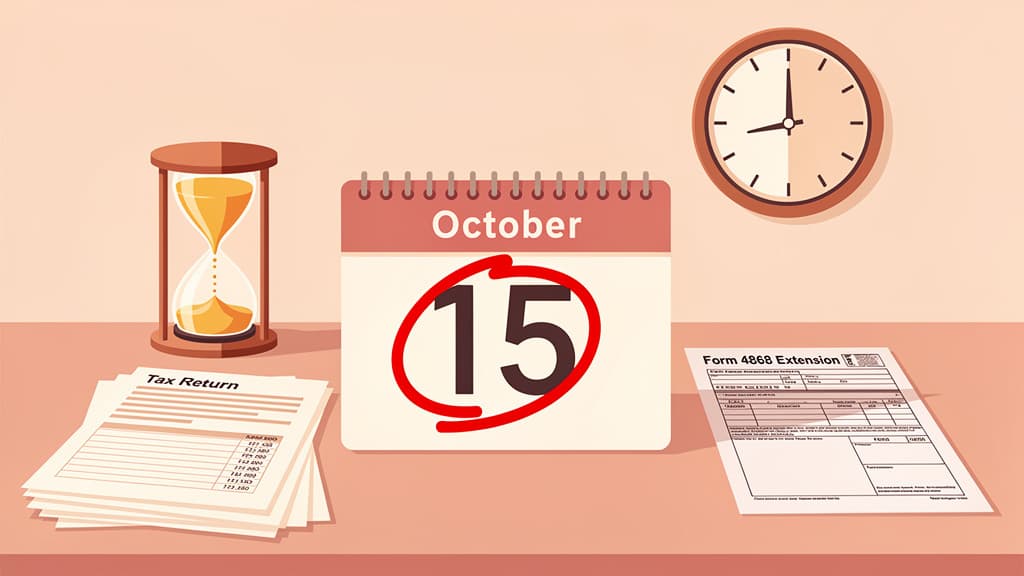
October 15, 2026 is the final deadline for extended tax returns. Learn what's due, who must file, and the penalties for missing it.
Read more
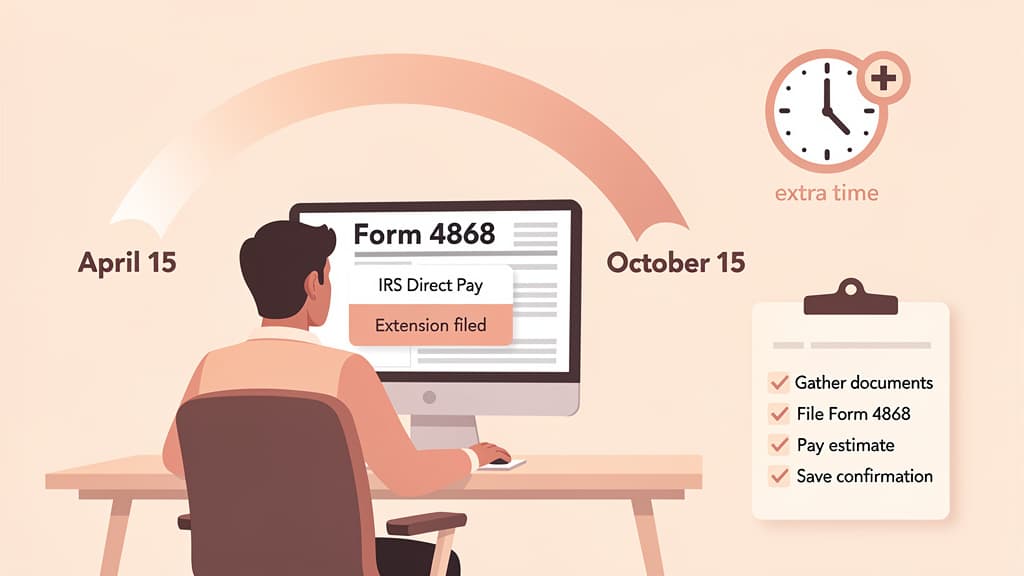
The deadline to request a tax extension for your 2025 return was April 15, 2026, and it has passed. If you already filed Form 4868, your extended filing deadline is October 15, 2026, and interest is accruing on any unpaid balance in the meantime. If you missed both the return and the extension, file as soon as possible: the failure-to-file penalty runs 5% of unpaid tax per month, ten times the 0.5% failure-to-pay rate.
Key takeaways:

Your extended 2025 return is due October 15, 2026. There is no second extension for individuals, so this date is final.
The expensive misunderstanding at this stage: Form 4868 extended your time to file, not your time to pay. Any 2025 tax you didn't pay by April 15, 2026 has been accruing the 0.5% monthly failure-to-pay penalty plus interest: 6% in Q2 2026 and 7% in Q3 2026 (July through September), compounded daily. Three moves cut the cost:
If you neither filed a 2025 return nor requested an extension by April 15, 2026, the extension window is closed. The only fix is filing the actual return, and every month or part of a month adds a failure-to-file penalty of 5% of the unpaid tax (when the failure-to-pay penalty also applies, the IRS reduces the failure-to-file charge by that amount, so the combined rate is 5% per month, up to 25%).
By mid-July 2026 that is three months of penalties: on a $5,000 unpaid balance, roughly $750 plus interest. Filing this week stops the biggest part of the meter.
Two relief options once you file:
All 2026 extension request deadlines below have passed. The table remains the reference for extended due dates and for the 2027 filing season.
| Form | Who It's For | Original Deadline | Extended Deadline |
|---|---|---|---|
| Form 4868 | Individuals / Sole Proprietors | April 15, 2026 | October 15, 2026 |
| Form 7004 | S-Corporations (1120-S) | March 16, 2026 | September 15, 2026 |
| Form 7004 | Partnerships (1065) | March 16, 2026 | September 15, 2026 |
| Form 7004 | C-Corporations (1120) | April 15, 2026 | October 15, 2026 |
| Form 8868 | Tax-Exempt Organizations (990) | May 15, 2026 | November 16, 2026 |
| Form 8892 | Gift Tax Returns (709) | April 15, 2026 | October 15, 2026 |
Form 4868 extends the filing deadline for individual returns (Form 1040), including sole proprietors who file Schedule C. Form 7004 is the business extension form: it covers partnership Form 1065, S-Corporation Form 1120-S, C-Corporation Form 1120, and most other business income tax returns. Both extensions are automatic, and neither extends the time to pay.
Legal basis: IRC §6081 (extension of time for filing returns), IRC §6651 (failure to file / failure to pay penalties)
Form 4868 gives individuals an automatic 6-month extension, moving the filing deadline from April 15 to October 15. Here's exactly how to file it.
Before filing the extension, you need a reasonable estimate of what you owe for the tax year. Look at your prior year return as a starting point. If your income was roughly the same, your tax liability should be similar. Factor in total income (W-2s, 1099s, investments), deductions (the 2025 standard deduction is $15,750 for single filers, or itemize), and any credits you expect to claim.
Add up all tax payments made toward your 2025 tax year: federal income tax withheld from paychecks (W-2), estimated tax payments (Q1 through Q4), and any other withholdings or credits applied.
Subtract what you've already paid (Step 2) from your estimated total liability (Step 1). If the result is positive, that's what you should pay with your extension. If you've overpaid, you'll get a refund when you file — but you still need to file the extension to avoid the failure-to-file penalty.
For 2025 returns, that deadline was April 15, 2026 (now passed). For 2026 returns, it's April 15, 2027. You have five methods to file. Choose whichever is most convenient:
IRS Free File (free). Go to irs.gov/freefile to file Form 4868 electronically. Available to all taxpayers regardless of income.
Tax software. TurboTax, H&R Block, TaxAct, and other providers support e-filing Form 4868. Usually the fastest option — under 5 minutes.
Tax professional. Your CPA or enrolled agent can file the extension on your behalf.
Mail paper Form 4868. Download from irs.gov, fill it out, and mail to the address in the form instructions. Use certified mail for proof of timely filing.
Make a payment and designate it as an extension. This is the method many people don't know about — more on this in the payment-as-extension section below.
Pay the balance due amount you calculated in Step 3 when you file the extension. You can pay via:
Paying at least 90% of your actual liability by the original deadline (and the rest when you file) avoids the failure-to-pay penalty. If you can't pay the full amount, pay as much as you can — penalties apply only to the unpaid portion.
Your extended return is due October 15, 2026. Set a reminder for mid-September to give yourself time to gather final documents and complete the return. Don't wait until October 14 — that's how extensions turn into late filings.
Form 7004 is the IRS corporate and business tax extension form, covering S-Corps, partnerships, C-Corps, and most other business income tax returns.
Your entity type determines both the original deadline and how much additional time you get:
| Entity Type | Form | Original Deadline | Extended Deadline |
|---|---|---|---|
| S-Corporation | 1120-S | March 16, 2026 | September 15, 2026 |
| Partnership / Multi-Member LLC | 1065 | March 16, 2026 | September 15, 2026 |
| C-Corporation (calendar year) | 1120 | April 15, 2026 | October 15, 2026 |
Note: Both 2026 extension request deadlines have passed (March 16 for S-Corps and partnerships, April 15 for C-Corps). If your 2025 business return is still unfiled, file it now: the S-Corp and partnership late-filing penalty accrues per shareholder or partner, per month. See our late filing penalties guide for the numbers and relief options.
Most S-Corps and partnerships are pass-through entities — they don't pay entity-level federal income tax. However, C-Corporations owe tax at the corporate level (21% flat rate), so you need to estimate and pay any balance due with the extension.
Even for pass-through entities, some states impose entity-level taxes (California's $800 franchise tax, for example). Check your state requirements.
Form 7004 is a simple, one-page form. E-file it through your tax software or tax professional. It requires your entity's name, address, EIN, the form number you're extending, and your estimated tax liability. File by the original return deadline — March 16 for S-Corps/partnerships, April 15 for C-Corps.
C-Corporations should pay their estimated tax liability with the extension. For pass-through entities, the business itself typically doesn't owe federal tax, but individual owners should ensure their personal estimated payments are up to date.
This distinction causes more expensive mistakes than any other part of the extension process.
| What an Extension DOES | What an Extension DOES NOT Do |
|---|---|
| Gives you 6 more months to file your return | Extend the deadline to pay taxes owed |
| Prevents the failure-to-file penalty (5% per month) | Stop interest from accruing on unpaid tax |
| Gives you time to gather missing documents (K-1s, corrected 1099s) | Extend quarterly estimated tax payment dates |
| Gives you time to make informed decisions about elections and deductions | Protect you from underpayment penalties |
| Is automatic — no reason or justification needed | Raise any red flags with the IRS |
The cost difference between filing and not filing is dramatic. The failure-to-file penalty is 5% of unpaid tax per month, maxing out at 25%. The failure-to-pay penalty is 0.5% per month. Filing an extension and not paying is ten times cheaper than not filing at all.
Here's something many taxpayers don't realize: if you pay what you owe through IRS Direct Pay or EFTPS and indicate the payment is part of filing for an extension (reason for payment: "Extension"), the IRS treats the payment itself as your extension request. You don't need to file a separate Form 4868. The IRS describes this on its Get an Extension page: "Pay what you owe using an online payment option and check the box that you are paying as part of filing for an extension."
How to do it:
You'll receive a confirmation number. Save it — this is your proof that you filed an extension. The IRS will record both the payment and the extension request.
This method works for any payment amount, including $0 — though paying nothing defeats the purpose of avoiding penalties on unpaid tax. It's most useful when you know you owe money and want to combine the extension request and payment into a single step.
Most states follow one of two approaches when you file a federal extension:
The majority of states automatically grant a state extension when you file a federal extension — no separate state form required. California goes further and gives every filer an automatic extension with no form at all. Illinois and Pennsylvania honor the federal extension, and Arkansas honors it if you check the extension box on your state return. Attach a copy of your federal extension confirmation when you file your state return.
A few states want their own extension filing even if you've filed a federal extension. Notable examples:
Rules differ state by state, so check your state revenue department's extension page before assuming the federal extension carries over.
If your state has no income tax, you don't need a state extension: Alaska, Florida, Nevada, New Hampshire, South Dakota, Tennessee, Texas, Washington, Wyoming. New Hampshire joined this list when its interest and dividends tax was repealed effective January 1, 2025.
Important: Even in states that auto-extend, state tax payments are still due by the original deadline. The extension covers filing, not payment — same rule as the IRS.
File anyway: the extension before the April deadline, or the return itself now that the deadline has passed.
Here's why: the failure-to-file penalty (5% per month of unpaid tax, up to 25%) is ten times worse than the failure-to-pay penalty (0.5% per month). When both apply in the same month, the IRS reduces the failure-to-file penalty by the failure-to-pay amount, so the combined charge is 5% per month. On a $5,000 unfiled, unpaid balance that's $250 per month. With an extension (or a filed return), it's just $25 per month plus interest. Over five months: $1,250 vs. $125. And once a return is more than 60 days late, a minimum penalty kicks in: $525 or 100% of the tax due, whichever is less, for returns due in 2026.
Interest accrues at the federal short-term rate plus 3 percentage points, compounded daily. For individuals that meant 7% in Q1 2026, 6% in Q2, and 7% again in Q3 (July through September). The sooner you pay, the less accumulates.
Individuals: No. There is no second extension for individual tax returns. October 15 is the final deadline, period. If you file after October 15, you'll owe the failure-to-file penalty on any unpaid tax.
Businesses: In very rare circumstances, a business can request additional time beyond the automatic extension. This is not automatic — it requires demonstrating "undue hardship" and is granted at the IRS's discretion. Most businesses should plan to file by the extended deadline.
Yes. U.S. citizens and resident aliens living outside the United States on the regular April deadline get an automatic 2-month extension to file (June 15, 2026 for 2025 returns) with no form required, just a statement attached to the return explaining which qualifying situation applies. Filing Form 4868 by June 15 extended that further, to October 15, 2026. One catch: interest still runs from the original April due date on any unpaid tax, even during the automatic 2-month window.
Filing an extension doesn't mean something went wrong. Here are the most common legitimate reasons:
Waiting for K-1s. If you're a partner or S-Corp shareholder, you can't complete your personal return until you receive K-1 forms. If the entity files for an extension (to September 15), your K-1 may not arrive until September — making a personal extension essential.
Multiple state returns. If you earned income in multiple states, preparing returns for each takes time. Getting one wrong can cause problems in all the others.
Complex transactions. Selling a business, exercising stock options, selling rental property, or completing a 1031 exchange all require careful handling. Rushing leads to errors.
Major life events. Marriage, divorce, death of a spouse, birth of a child, inheritance — these change your tax situation and may require additional documentation.
Starting a business mid-year. Your first year in business creates unique situations: startup cost deductions, vehicle allocation, home office setup, and accounting method elections. Taking extra time to get these right saves money in future years.
Filing the extension is step one. Here's what to do between April and October so you don't end up scrambling at the last minute. Reading this mid-year? Jump in at the current month.
April (after filing). Confirm your extension was accepted. Organize all documents you have. List what's missing and set deadlines to obtain it.
May–June. Follow up on missing K-1s and corrected 1099s. Make your Q2 estimated payment (due June 15) for the current tax year. Begin drafting your return.
July–August. Most missing documents should be available. Start preparing your return or send materials to your tax preparer.
September. Extended S-Corp and partnership returns are due September 15 — K-1s should arrive soon after. Make your Q3 estimated payment (due September 15). Finalize return preparation.
October. Your return should be substantially complete by October 1. File by October 15. Pay any additional tax with the return to stop interest from accruing.
This is mistake number one, every year. Filing the extension avoids the failure-to-file penalty, but it does nothing to stop interest and the failure-to-pay penalty from accumulating on unpaid tax. Estimate what you owe and pay it by the April deadline, even if the number isn't perfect. Overpaying slightly and getting a refund is far cheaper than underpaying and owing penalties.
About 19 million Americans file extensions each year — high-income earners, business owners with complex situations, people waiting on documents from entities they don't control. The IRS designed the extension system to be automatic and routine. There is no stigma, no audit flag, and no downside — as long as you pay your estimated tax on time.
You filed your federal extension — but did you check your state? Most states auto-extend when you file federally, but a few require a separate filing. And even in auto-extend states, you still owe state tax by the original state deadline. Don't assume the federal extension covers everything.
Six extra months sounds like a lot of time. It goes fast. The most common extension mistake is treating October 15 the way you treated April 15 — waiting until the last minute. Start working on your return no later than September 1 to give yourself a comfortable cushion.
When you're filing an extension, the hardest part is Step 1: estimating your total tax liability. If your books aren't organized, that estimate is a guess — and a bad guess means either overpaying (tying up cash you need) or underpaying (triggering penalties and interest).
Jupid connects to your bank accounts and automatically categorizes your income and expenses with 95.9% accuracy. That means when extension season arrives, you already have a clear picture of your year-to-date financials. Your estimated tax liability isn't a rough guess — it's based on actual transaction data.
After you file the extension, Jupid keeps tracking. As income comes in during the extended filing period, the AI updates your estimated liability so you can make adjustments before October. If you made quarterly estimated payments, Jupid tracks those too — so you know exactly what you've paid and what's remaining.
You can check your tax status anytime through Jupid's WhatsApp and iMessage AI. Ask "How much do I owe for 2025?" and get an answer based on your real bank transactions. Jupid works via the web interface, Claude Code, and other AI tools — however you prefer to work.
Connect your bank to Jupid and turn your extension estimate from a guess into a number you can trust.
Filing a tax extension is a five-minute task that buys you six months. The process is straightforward: estimate what you owe, pay it, submit the form, and mark the extended deadline on your calendar. The IRS grants extensions automatically — no questions asked, no reason required.
For 2025 returns, the request window closed on April 15, 2026. If you're on extension, October 15, 2026 is the date that matters now; if you missed both deadlines, filing the return this week is the cheapest available move.
The key is to separate the filing decision from the payment decision. File no matter what, then pay as much as you can. A correct return filed in October is always better than a rushed, error-filled return filed in April.
Disclaimer
This article provides general information about filing tax extensions in 2026 and should not be considered tax advice. Extension rules, deadlines, and penalty calculations vary based on your tax situation, entity type, and state of residence. For advice tailored to your circumstances, consult a qualified tax professional or refer to IRS Publication 509.
Last Updated: July 11, 2026

CEO & Co-Founder
Fintech CEO with 10+ years building accounting and financial technology products. Previously co-founded and scaled an AI-powered accounting platform to $30M revenue and 100K+ business users, achieving 30,000 customers per accountant through automation — recognized by CNBC as a top fintech company. Holds a Master's in Management Information Systems. At Jupid, he leads the development of AI-native bookkeeping, tax, and compliance tools designed for freelancers and small business owners.
October 15, 2026 is the final deadline for extended tax returns. Learn what's due, who must file, and the penalties for missing it.

How to file a tax extension in 2026 using Form 4868 or Form 7004. Covers deadlines, penalties, payment rules, state extensions, and when extensions make sense.

Find out when your 2026 tax refund will arrive based on your filing date, method, and IRS processing times for e-file and paper returns.
New here? Enter this code at checkout and your first month is on us — full AI bookkeeping, tax filing, and a 24/7 accountant, $0 for 30 days.
New customers. First month free with code NEW2026, cancel anytime.
Join 1,000+ businesses using Jupid to save time and money. Start simplifying your finances today.
30-day money-back guarantee