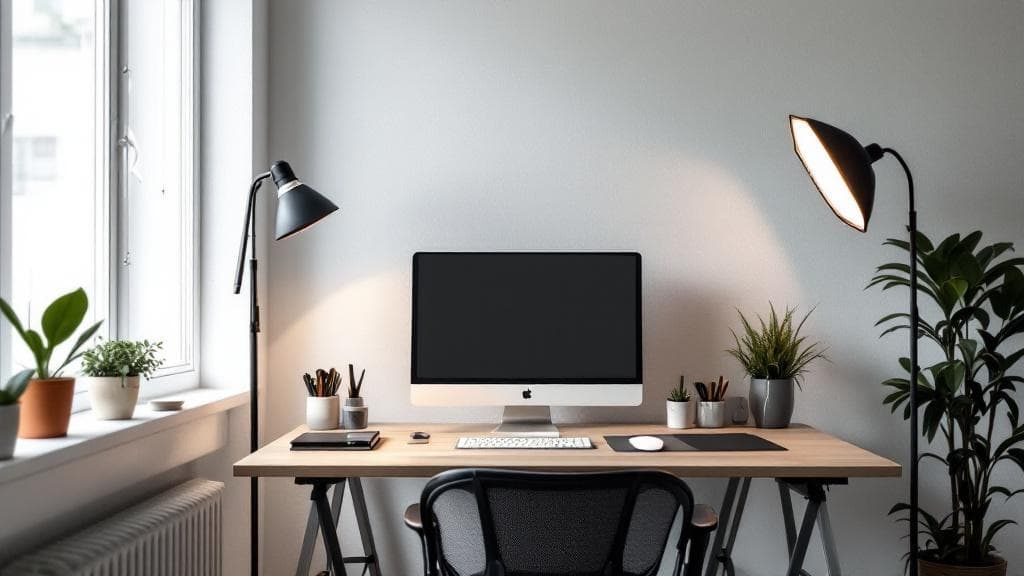
Self-employed people who use part of their home exclusively and regularly for business can deduct either $5 per square foot of office space (up to 300 square feet, $1,500 maximum) or the business-use share of actual housing costs — rent or mortgage interest, utilities, insurance, and depreciation — on Form 8829. W-2 employees cannot claim the home office deduction, even for full-time remote work: the Tax Cuts and Jobs Act suspended it for employees in 2018, and the One Big Beautiful Bill Act (OBBBA) made that suspension permanent in July 2025. The rules and rates below apply to both 2025 returns (filed in 2026) and tax year 2026.
Key takeaways:
- Two methods: simplified ($5/sq ft, max 300 sq ft = $1,500 cap) or actual expenses on Form 8829 (no dollar cap, limited by business income)
- Core tests: the space must be used exclusively and regularly for business, and it must be your principal place of business (or meet a client-meeting, separate-structure, inventory-storage, or daycare test)
- W-2 employees can't claim it: the TCJA suspension is now permanent under OBBBA
- Renters qualify the same way homeowners do; rent replaces mortgage interest in the calculation
- The deduction is capped by business income under both methods; only the actual-expense method carries the excess forward
The home office deduction allows business owners to deduct expenses associated with using part of their home for business purposes. This deduction is authorized under Internal Revenue Code Section 280A and applies whether you own or rent your home.
Legal Basis: IRC §280A permits deductions for "a portion of a dwelling unit which is exclusively used on a regular basis as the principal place of business for any trade or business of the taxpayer."
The deduction isn't just for traditional "offices"—it applies to:
- Home offices
- Studios
- Workshops
- Labs
- Any dedicated business workspace in your home
For a business owner with a 300 square foot office in a 1,200 square foot apartment renting at $2,000/month (25% business use), the actual-expense method produces:
- Rent deduction: $24,000 × 25% = $6,000 annually
- Utilities deduction: $4,800 × 25% = $1,200 annually
- Combined tax savings: roughly $2,500 per year in the 22% bracket, counting both income tax and self-employment tax
The good news: If you run a business from home, you likely qualify. The bad news: The IRS has specific requirements you must meet.
✅ You CAN claim if you are:
- Sole proprietor
- Independent contractor or freelancer
- Partnership member
- LLC owner
- S Corporation owner (through an accountable reimbursement plan, since you're technically a W-2 employee of your corporation; see Special Rules below)
- Self-employed professional
❌ You CANNOT claim if you are:
- W-2 employee (even fully remote)
- Hobby participant (not a business)
- Investor managing personal investments
No. The Tax Cuts and Jobs Act (TCJA) suspended the home office deduction for employees starting in 2018, and the One Big Beautiful Bill Act (OBBBA), signed July 4, 2025, made that suspension permanent by eliminating miscellaneous itemized deductions for good. Working from home full time, even at your employer's request, creates no deduction on your federal return. Two workarounds exist: ask your employer for an accountable-plan reimbursement (tax-free to you, deductible for them), or claim the deduction against a Schedule C side business you run from a separate qualifying space. A few states, California among them, never conformed to the TCJA change and still allow unreimbursed employee expenses on the state return.
Yes. The home office deduction works identically for renters and homeowners. Renters deduct the business percentage of rent, renters insurance, and utilities under the actual-expense method, or take the $5/sq ft simplified rate. Homeowners deduct mortgage interest, property taxes, insurance, and depreciation instead. Renters often come out ahead on the actual-expense method: rent is fully allocable, and there is no depreciation recapture to think about when moving out.
To qualify for the home office deduction, you must first meet three fundamental requirements as specified in IRS Publication 587:
You must use your home office regularly for business purposes.
What "regular" means:
- Continuing basis: IRS Publication 587 states that "incidental or occasional business use is not regular use"
- A consistent schedule (every weekday morning, for example) satisfies the test
- There is no minimum-hours rule; consistency matters more than volume
Example:
✅ Sarah uses her home office 15 hours per week, every week → Qualifies
❌ Tom uses his home office once a month for paperwork → Doesn't qualify
You must use your home office space exclusively for business—not for personal activities.
What "exclusive" means:
- The space is used ONLY for business purposes
- No personal use of the space (even minor use disqualifies you)
- Exception: Inventory storage and day care centers
Common Scenarios:
| Scenario | Qualifies? |
|---|
| Dedicated spare bedroom used only as office | ✅ Yes |
| Corner of living room with desk, used only for work | ✅ Yes |
| Guest bedroom with desk that hosts guests occasionally | ❌ No |
| Den with business desk and personal TV viewing | ❌ No |
Pro Tip: You don't need an entire room. You can use part of a room as long as that specific area is used exclusively for business. Consider using room dividers or furniture placement to clearly delineate your workspace.
You must actually be conducting a trade or business, not a hobby or investment activity.
Profit Presumption: If you show a profit in 3 out of 5 consecutive years, the IRS presumes you're in business (not a hobby).
After meeting the three threshold requirements, you must satisfy at least one of these five additional tests:

Your home office qualifies if it's your principal place of business.
You meet this test if:
A) You work only from home
- Straightforward case—your home is clearly your principal place of business
- Example: Writer who writes exclusively at home
B) You work in multiple locations, but do your most important work at home
- "Most important" = activities that directly generate your income
- Example: Software developer codes at home (30 hrs/week) and meets clients offsite (10 hrs/week) → Home is principal place
C) You perform administrative/management activities at home with no other fixed location
- You can do most work elsewhere, BUT
- You handle your administrative tasks at home
- No other fixed location where you conduct substantial administrative or management activities (Publication 587's exact standard)
Administrative/Management Activities Include:
- Billing clients/customers
- Keeping books and records
- Ordering supplies
- Setting up appointments
- Writing reports
- Research and planning
Real-World Example:
Maria the Contractor
Maria is a general contractor who spends 80% of her time at job sites. She has a home office where she:
- Prepares bids and estimates
- Orders materials
- Does bookkeeping
- Schedules jobs
- Meets with subcontractors occasionally
Result: Maria qualifies! Even though most of her work happens at job sites, her home office is where she conducts all administrative activities, and she has no other fixed office location.
You qualify if you physically meet with clients, customers, or patients at your home office regularly.
Requirements:
- Physical meetings (phone calls don't count)
- Regular basis (a Publication 587 example treats an attorney who meets clients in a home office two days a week as qualifying)
- Exclusive use (the meeting space must be used only for business)
Pro Tip: Keep an appointment book or calendar showing client visits to document this requirement.
You qualify if you use a separate freestanding structure on your property exclusively and regularly for business.
Qualifying Structures:
- Detached garage
- Studio
- Barn
- Greenhouse
- Workshop
- Guest house (if used exclusively for business)
You qualify if you:
- Sell retail or wholesale products
- Store inventory or product samples at home
- Have no other business location
- Regularly use a specific space for storage
Special Benefit: You don't need exclusive use for inventory storage—just regular use of a specific area.
You qualify if you operate a licensed day care facility in your home for:
- Children
- Adults 65 or older
- Physically or mentally disabled individuals
Once you've confirmed you qualify, it's time to calculate your deduction. The IRS offers two methods; run your numbers through both with our home office deduction calculator before you pick.
Introduced: Revenue Procedure 2013-13 (available from 2013 forward)
How it works:
- $5 per square foot of home used for business
- Maximum 300 square feet
- Maximum deduction: $1,500
- The rate is fixed by Revenue Procedure 2013-13 and is not indexed to inflation: the same $5 and 300 sq ft figures applied for 2022-2024 returns and apply for 2025 and 2026
Advantages:
✅ Extremely simple—no detailed record keeping
✅ No depreciation deduction (so no depreciation recapture when you sell your home)
✅ Can claim full home-related itemized deductions on Schedule A
Disadvantages:
❌ Capped at $1,500
❌ Still limited to your business's gross income, and the shortfall cannot carry forward
❌ Usually results in smaller deduction than regular method
Example Calculation:
Home office size: 200 square feet
Calculation: 200 sq ft × $5 = $1,000 deduction
Legal Basis: IRC §280A, IRS Publication 587
You claim the regular method on Form 8829, filed with Schedule C. This section covers the calculation logic; for the form itself, our Form 8829 line-by-line guide walks through all 44 lines, the Line 11 Worksheet, and the carryover rules.
How it works:
- Determine percentage of home used for business
- Calculate actual expenses
- Multiply expenses by business percentage
- Claim depreciation on business portion of home
Step 1: Calculate Your Business Percentage
You can use either approach (choose the one that gives you a larger percentage):
Option A: Square Footage Method
Business Percentage = (Office Square Feet ÷ Total Home Square Feet) × 100

Example:
Office: 400 sq ft
Home: 1,600 sq ft
Business %: (400 ÷ 1,600) × 100 = 25%
Pro Tip: You can exclude common areas (hallways, stairs, landings) and areas not used for business (attics, garages) from your total to increase your percentage.
Option B: Room Method
Business Percentage = (Rooms Used for Business ÷ Total Rooms) × 100

Requirements:
- All rooms must be approximately the same size
- Don't count bathrooms, closets, storage areas
Why Room Method Often Works Better: Unless you live in a mansion or have unusually large rooms, the room method typically yields a higher percentage and larger deduction.
Step 2: Identify Deductible Expenses
Definition: Expenses that benefit ONLY your home office.
Examples:
- Painting your office
- Office carpet or flooring
- Office repairs
- Office improvements
Deduction: 100% deductible
Definition: Expenses that benefit your entire home, including your office.
Examples:
- Mortgage interest or rent
- Property taxes
- Homeowners/renters insurance
- Utilities (electric, gas, water, sewer, trash)
- Home repairs and maintenance
- Security system
Deduction: Business percentage only
SALT cap note: If the state and local tax cap ($40,000 on 2025 returns, $40,400 for 2026) limits your property tax deduction on Schedule A, the business share of those taxes is still deductible. Form 8829 moves it to the "excess real estate taxes" line, where it counts against business income instead.
Example:
Your annual home expenses:
- Rent: $24,000
- Utilities: $3,600
- Insurance: $1,200
- Total: $28,800
Business percentage: 25%
Deduction: $7,200 ($28,800 × 25%)
If you own your home, you can also depreciate the business portion.
Depreciation Calculation:
1. Determine your home's adjusted basis (usually purchase price minus land value)
2. Multiply by your business percentage
3. Divide by 39 years (business use of a home is depreciated as 39-year nonresidential real property)
4. Result = Annual depreciation deduction
Important: When you sell your home, you must recapture (pay tax on) the depreciation you claimed, at a maximum rate of 25%. The home sale exclusion (up to $250,000 for single, $500,000 for married) still applies to the rest of your gain. Recapture only hits the actual-expense method; the simplified method claims zero depreciation. It also covers depreciation "allowed or allowable," meaning amounts you were entitled to claim even in years you skipped them, so if you use Form 8829, claim it.
Scenario:
- Home: 2,000 sq ft
- Office: 300 sq ft (15%)
- Annual expenses:
- Mortgage interest: $12,000
- Property taxes: $4,000
- Insurance: $1,500
- Utilities: $3,000
- Repairs/maintenance: $2,000
- Direct office expenses: $500
- Home basis (building only): $200,000
Calculation:
| Expense | Amount | Business % | Deduction |
|---|
| Mortgage interest | $12,000 | 15% | $1,800 |
| Property taxes | $4,000 | 15% | $600 |
| Insurance | $1,500 | 15% | $225 |
| Utilities | $3,000 | 15% | $450 |
| Repairs | $2,000 | 15% | $300 |
| Direct expenses | $500 | 100% | $500 |
| Depreciation | $200,000 ÷ 39 | 15% | $769 |
| TOTAL | | | $4,644 |
Tax savings: the $4,644 deduction cuts self-employment tax by $4,644 × 92.35% × 15.3% = $656, and income tax by about $950 in the 22% bracket (slightly less than $4,644 × 22% because the deduction also shrinks the ½-SE-tax deduction). Combined: roughly $1,600.
Choose Simplified Method if:
✅ Your home office is small (under 300 sq ft)
✅ You want minimal paperwork
✅ You plan to sell your home soon (avoid depreciation recapture)
Choose Regular Method if:
✅ Your home office is larger than 300 sq ft
✅ You have high housing costs (rent/mortgage)
✅ You want to maximize your deduction
✅ You're willing to maintain detailed records
- Calculate your business percentage
- Estimate total eligible expenses
- Multiply: Expenses × Business % = Potential regular method deduction
- Compare to simplified method: Square footage × $5 (max $1,500)
- Choose the higher amount
Tax Form: Schedule C (Form 1040), attach Form 8829
Profit Limitation:
Your home office deduction cannot exceed the gross income from the business use of your home. The limit applies under both methods, but only the regular method lets you carry unused amounts forward to future years (Form 8829, lines 43-44).
Best Practice for S Corps:
Set up an accountable reimbursement plan. Calculate your home office expenses and submit monthly or quarterly expense reports to your corporation for reimbursement.
Current rules (permanent under OBBBA):
- Cannot claim home office deduction as employee
- Must use accountable reimbursement plan
- Corporation deducts reimbursement
- You receive tax-free reimbursement
❌ Wrong: Using your home office for business during the day and watching TV there at night
✅ Right: Using the space exclusively for business, keeping all personal activities in other areas
❌ Wrong: Setting up a desk but using it only occasionally
✅ Right: Using your home office consistently (ideally daily or at minimum several times per week)
❌ Wrong: Claiming your entire 1-bedroom apartment as office space when you clearly need somewhere to sleep
✅ Right: Being realistic about the space actually used exclusively for business
❌ Wrong: No measurements, no receipts, no records
✅ Right: Documented measurements, photos of office setup, organized expense receipts
❌ Wrong: Skipping the deduction due to audit fears or complexity
✅ Right: Claiming legitimate deductions you're entitled to
Reality check: IRS audit rates for sole proprietors have run near 1% or below in recent years, and proper documentation protects you if you are audited.
For All Taxpayers
1. Home Office Measurements
- Diagram or floor plan showing office location
- Square footage calculations
- Photos of home office setup
- Documentation that space is used exclusively for business
2. Expense Records
- Receipts for all deductible expenses
- Bank statements and canceled checks
- Credit card statements
- Mortgage statements or lease agreement
- Utility bills
- Insurance policies
- Repair and maintenance invoices
3. Business Use Documentation
- Calendar or log showing regular business use
- Client meeting records (if claiming meeting space)
- Business activity records
| Record Type | Retention Period |
|---|
| General home office records | 3 years from filing date |
| Records if you understated income by 25%+ | 6 years |
| Depreciation and home basis records | 3 years after you sell home |
| Employment tax records | 4 years |
| Property records (basis, improvements) | Indefinitely (until 3 years after sale) |
IRS Source: IRS Publication 583 - Starting a Business and Keeping Records
Profile:
- Freelance writer
- 200 sq ft home office
- Works exclusively from home
- Gross income: $80,000
- Other business expenses: $15,000
Calculation: 200 sq ft × $5 = $1,000 deduction. Self-employment tax saved: $1,000 × 92.35% × 15.3% = $141. Income tax saved in the 22% bracket: about $204. Combined savings: roughly $345.
Profile:
- Business consultant
- 350 sq ft office in 1,500 sq ft rented apartment
- Monthly rent: $2,500
- Annual utilities, insurance: $6,000
Calculation: business percentage 350 ÷ 1,500 = 23.3%. Rent: $30,000 × 23.3% = $6,990. Utilities and insurance: $6,000 × 23.3% = $1,398. Total deduction: $8,388. Savings: $1,185 in self-employment tax plus about $1,870 of income tax in the 24% bracket, or roughly $3,050 combined.
Profile:
- Online product seller
- 500 sq ft garage used 50% for inventory
- 2,000 sq ft home
- Owns home ($300,000 basis)
- Annual home expenses: $18,000
Calculation: storage space 250 sq ft (50% of the garage). Business percentage: 250 ÷ 2,000 = 12.5%. Indirect expenses: $18,000 × 12.5% = $2,250. Depreciation: $300,000 ÷ 39 × 12.5% = $962. Total deduction: $3,212. Savings: $454 in self-employment tax plus about $657 of income tax in the 22% bracket, or roughly $1,110 combined.
- Internal Revenue Code Section 280A - Business use of home deductions
- 26 CFR § 1.280A-2 - Treasury Regulations on home office deductions
- Soliman v. Commissioner, 506 U.S. 168 (1993) - The narrow principal-place-of-business test that Congress later overrode by adding the administrative/management rule to IRC §280A (effective 1999)
The actual-expense method lives or dies on records: twelve months of rent or mortgage statements, utility bills, insurance premiums, and repair receipts. Jupid connects to your bank and categorizes every transaction automatically with 95.9% accuracy, so home-related expenses are already sorted by the time you calculate the deduction. Forward a repair receipt over WhatsApp or iMessage and Jupid attaches it to the matching transaction. Deciding between the simplified rate and Form 8829? Ask your AI accountant in chat and get an answer based on your actual spending, not estimates.
Try Jupid
The home office deduction is one of the most valuable tax benefits available to small business owners, and one that many eligible filers skip out of audit fear or paperwork dread.
The key is understanding the requirements, maintaining proper documentation, and claiming the deduction correctly. With this guide, you now have the knowledge to confidently claim your home office deduction and keep more of your hard-earned income.
Remember:
- You don't need a separate room—just exclusive business use of a defined space
- Regular use means consistent, not necessarily full-time
- Proper documentation protects you in an audit
- The deduction applies whether you own or rent
- You can switch methods year to year to maximize benefits
Disclaimer
This article provides general information about tax deductions and should not be considered tax advice. Tax laws change frequently, and individual circumstances vary significantly. For advice specific to your situation, consult with a qualified tax professional.
Last Updated: July 11, 2026
Tax Years: 2025 (returns filed in 2026) and 2026 — the home office rules and rates are identical for both